
Automotive radar has become an important sensing technology for modern vehicles and advanced driver assistance systems (ADAS).
As automotive radar systems move into the 77 GHz and millimeter-wave frequency range, every part of the RF signal chain must meet increasingly demanding requirements. This includes antennas, RF modules, connectors, PCBs, and coaxial cables.
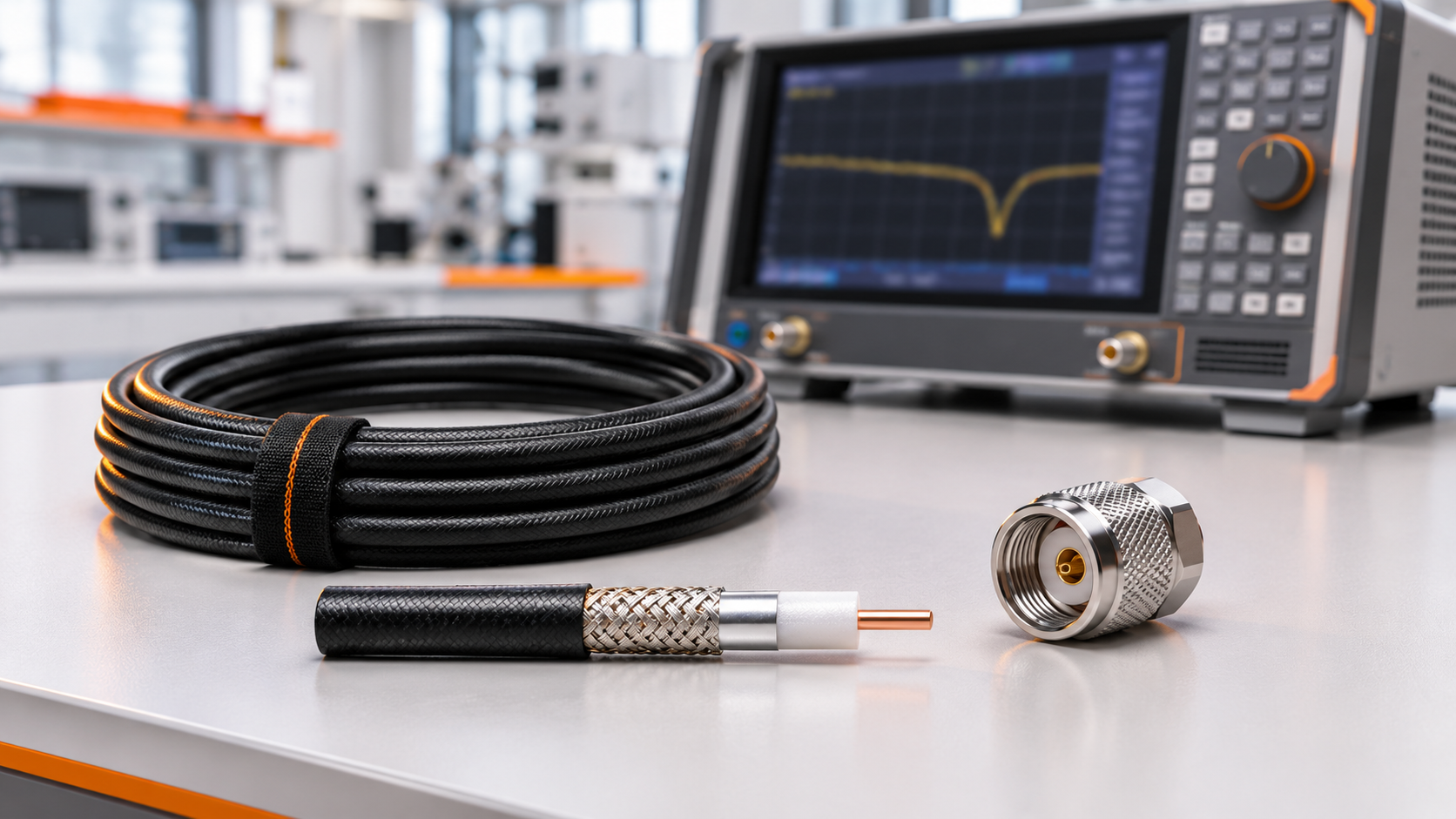
A high-performance RF cable can play an important role in maintaining signal integrity between critical components.
Why Is 77 GHz Used in Automotive Radar?
The 77 GHz frequency range is widely used for automotive radar because millimeter-wave radar can provide precise information about objects, including their distance and relative velocity.
Applications include:
- Adaptive cruise control
- Forward collision warning
- Automatic emergency braking
- Blind-spot detection
- Parking assistance
- Surround sensing
- Advanced driver assistance systems
At these frequencies, however, RF losses and impedance discontinuities become increasingly important.
Why Does Cable Loss Matter?
Signal attenuation increases with frequency.
In a radar system, excessive insertion loss can reduce the available signal power and affect the overall RF link budget.
For this reason, automotive radar cables need to provide low and predictable attenuation while maintaining appropriate impedance characteristics.
The cable structure, conductor material, dielectric, shielding system, and connector interface all contribute to the final RF performance.
Why Is Impedance Control Important?
A typical RF system is designed around a specific characteristic impedance.
If the cable and connected components are not properly matched, signal reflections can occur.
These reflections can affect:
- Return loss
- VSWR
- Signal integrity
- Transmitted power
- Measurement accuracy
Precise dimensional control during cable manufacturing is therefore essential for high-frequency applications.
Phase Stability in Automotive Radar
Automotive environments are exposed to temperature changes, vibration, mechanical movement, and other environmental conditions.
For phase-sensitive RF systems, changes in cable electrical length can result in phase variation.
Phase-stable cable designs help minimize changes caused by bending and temperature variations, supporting consistent RF performance in demanding environments.
Shielding and Electromagnetic Compatibility
Automotive systems contain many electronic components operating simultaneously.
A well-designed coaxial cable provides shielding around the signal conductor, helping reduce electromagnetic interference and unwanted coupling.
High-shielding cable structures can therefore be particularly valuable in compact RF systems where multiple signal paths are located close to one another.
Designing Cables for 77 GHz Applications
A cable intended for automotive radar should be evaluated based on more than its stated maximum frequency.
Engineers should also consider:
- Insertion loss
- Return loss / VSWR
- Phase stability
- Shielding effectiveness
- Temperature performance
- Mechanical durability
- Bend radius
- Connector compatibility
- Cable dimensions
The complete cable assembly must be considered as part of the RF system.
Fengsheng Communication Automotive Radar Cable Solutions
Fengsheng Communication develops high-frequency coaxial cable solutions for demanding RF applications, including automotive radar and other microwave and millimeter-wave systems.
By focusing on controlled cable geometry, material selection, shielding design, and manufacturing consistency, we aim to provide reliable RF interconnect solutions for advanced electronic systems.
As automotive radar technology continues to evolve, reliable high-frequency cable technology will remain an important part of the signal transmission chain.