
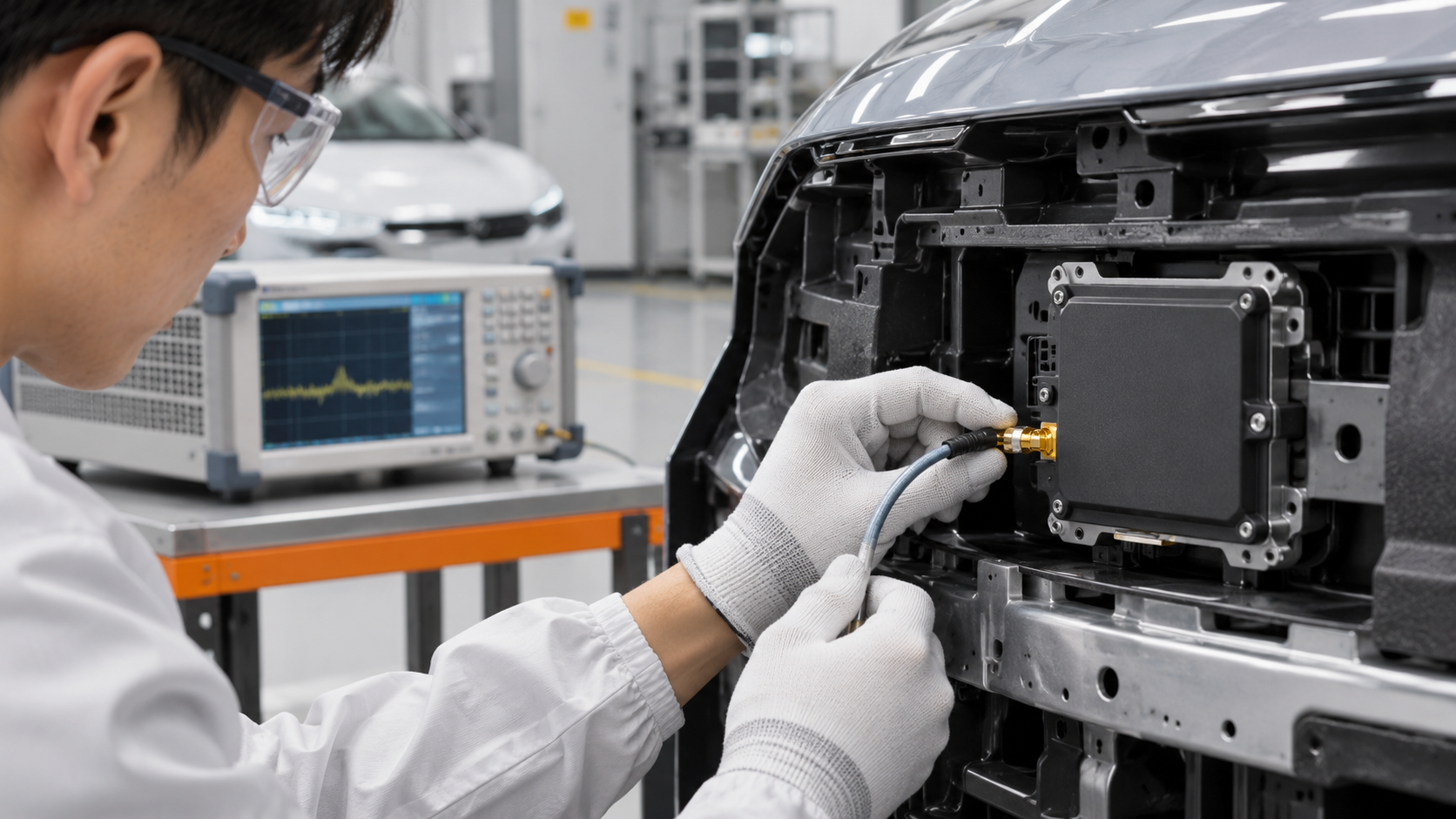
The development of advanced wireless communication technologies is driving RF systems toward higher frequencies, wider bandwidths, and increasingly complex antenna architectures.
As 5G-Advanced and future 6G technologies continue to develop, maintaining signal integrity across the RF interconnection system is becoming increasingly important.
This creates growing demand for low-loss, phase-stable, high-shielding coaxial cables.
Why Do Higher Frequencies Increase Cable Requirements?
As operating frequency increases, conductor and dielectric losses become more significant.
Even relatively short cable connections can contribute measurable attenuation at high frequencies.
For this reason, RF cables used in advanced communication systems need carefully optimized conductor, dielectric, and shielding structures.
Why Is Phase Stability Important?
Modern communication systems increasingly rely on multiple RF channels and antenna arrays.
When signals from different channels must maintain a controlled phase relationship, cable phase variation can affect system performance.
Phase changes may result from:
- Temperature variation
- Cable bending
- Mechanical stress
- Dielectric changes
- Manufacturing variation
Phase-stable coaxial cables are designed to minimize these effects.
Low Loss and Phase Stability Must Work Together
A high-performance RF cable should not be evaluated on insertion loss alone.
For advanced RF applications, engineers may need to consider the combined performance of:
Low Insertion Loss + Stable Phase + Low VSWR + High Shielding + Temperature Stability + Mechanical Reliability
The balance between these characteristics determines whether a cable is suitable for a specific application.
6G and Millimeter-Wave Applications
As research and development moves toward higher-frequency 6G systems, millimeter-wave technologies are expected to play an increasingly important role.
High-frequency cables will be needed for applications such as:
- RF research and development
- Antenna testing
- Phased-array systems
- Microwave measurement
- Satellite communication
- High-frequency communication equipment
- Millimeter-wave testing
At these frequencies, manufacturing consistency becomes increasingly important because small dimensional variations can affect electrical performance.
Manufacturing Matters
The performance of a precision coaxial cable depends on the entire manufacturing process.
Conductor dimensions, dielectric uniformity, concentricity, shielding density, material properties, and manufacturing tension can all influence the final electrical characteristics.
Consistent manufacturing processes therefore play an important role in producing reliable high-frequency cables.
Fengsheng Communication’s High-Frequency Cable Solutions
Fengsheng Communication focuses on RF coaxial cables, low-loss phase-stable coaxial cables, and special communication cables.
Through continuous development in materials, cable structures, manufacturing processes, and quality control, we provide high-performance interconnect solutions for advanced RF and communication applications.
As wireless communication continues to move toward higher frequencies and more sophisticated architectures, reliable RF cable technology will remain an essential part of the communication infrastructure.