
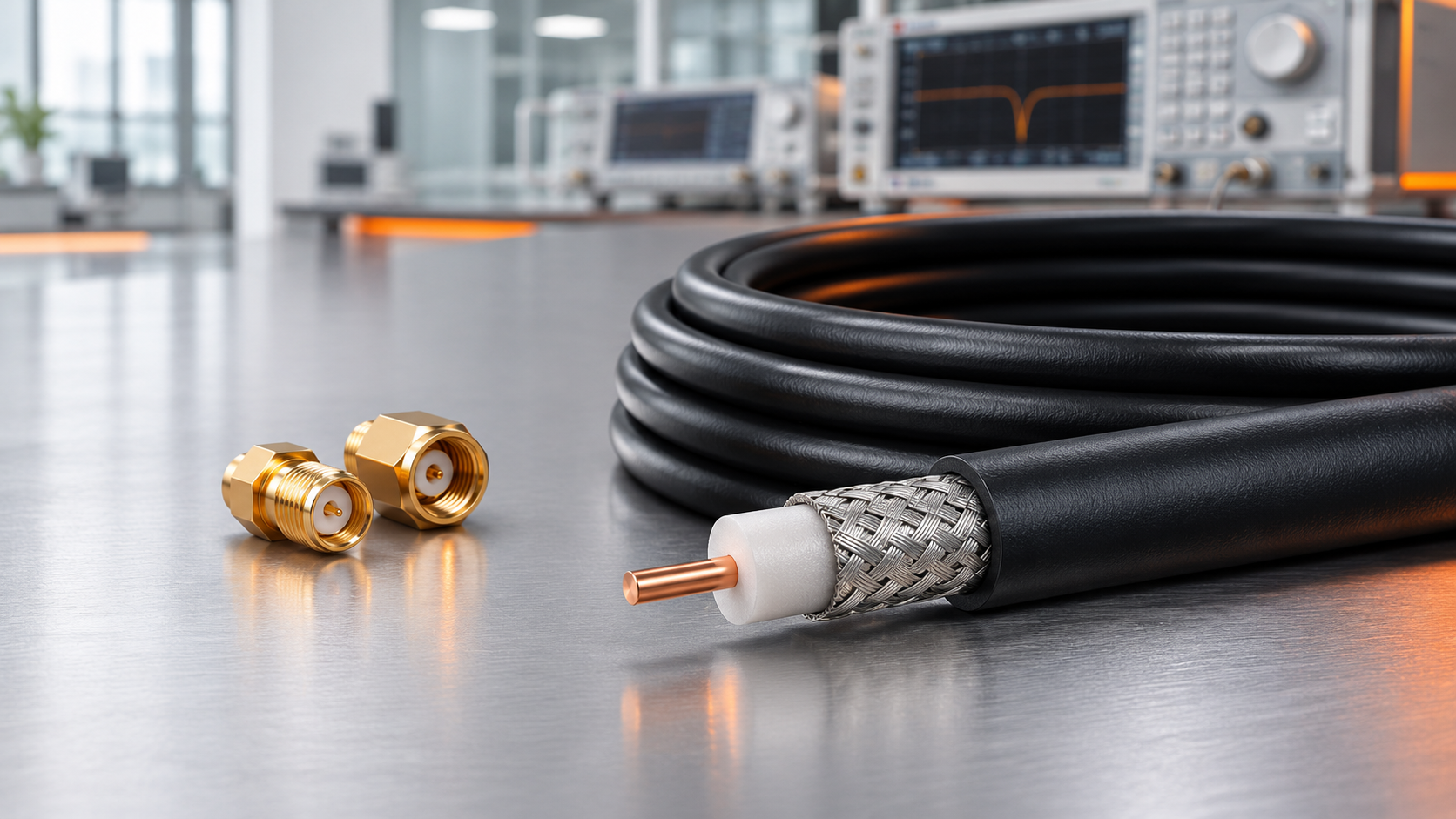
In modern RF and microwave systems, signal integrity depends not only on the performance of electronic components but also on the quality of the cables connecting them.
As communication systems move toward higher frequencies and more precise signal processing, conventional coaxial cables may no longer provide the required level of loss, phase consistency, and environmental stability. This is where low-loss phase-stable coaxial cables become increasingly important.
What Is a Low-Loss Coaxial Cable?
A low-loss coaxial cable is designed to minimize signal attenuation during transmission.
At higher frequencies, conductor loss and dielectric loss become increasingly important. Excessive cable loss can reduce signal power and negatively affect the link budget, measurement accuracy, and overall system performance.
For this reason, low-loss coaxial cables are widely used in RF communication, microwave systems, radar, satellite communication, and test and measurement equipment.
What Does “Phase Stable” Mean?
Phase stability refers to the ability of a cable to maintain a consistent electrical phase when exposed to environmental or mechanical changes.
Cable bending, flexing, temperature changes, and mechanical stress can alter the electrical length of a conventional coaxial cable. In phase-sensitive applications, even relatively small phase variations can affect system accuracy.
Phase-stable cables are therefore designed to minimize phase changes caused by:
- Temperature variations
- Cable bending
- Flexing and movement
- Mechanical stress
- Changes in dielectric properties
Why Is Phase Stability Important?
Phase stability is particularly important in systems where multiple RF signals must maintain a precise phase relationship.
Typical applications include:
- Phased-array antennas
- Radar systems
- Vector network analyzers
- Microwave measurement equipment
- Satellite communication
- Aerospace electronics
- 5G and 6G RF systems
- High-frequency test equipment
In phased-array systems, for example, controlled phase relationships between different channels are essential for accurate beamforming.
The Role of the Dielectric Material
The dielectric material is one of the most important elements affecting coaxial cable performance.
PTFE is widely used in high-frequency coaxial cables because of its excellent electrical properties, thermal resistance, and chemical stability. However, temperature-dependent dielectric behavior must be carefully considered when designing cables for precision RF applications.
Advanced cable structures and carefully controlled dielectric processing can help improve phase stability over temperature and during flexure.
Key Performance Parameters
When selecting a low-loss phase-stable coaxial cable, engineers should consider:
Insertion Loss
Lower attenuation helps preserve signal strength.
VSWR / Return Loss
Good impedance matching helps minimize signal reflections.
Phase Stability
Important for phase-sensitive and multi-channel RF systems.
Shielding Effectiveness
High shielding helps reduce electromagnetic interference and channel-to-channel coupling.
Operating Temperature
The cable should maintain its electrical performance throughout the required temperature range.
Mechanical Flexibility
Flexure performance is particularly important for test cables and moving systems.
Fengsheng Communication’s RF Cable Solutions
Huizhou Fengsheng Communication Cable Technology specializes in high-performance RF coaxial cables and special communication cables.
Our product development focuses on key requirements including low insertion loss, stable amplitude and phase, high shielding effectiveness, high-temperature resistance, and reliable signal transmission.
By combining material selection, precision structural design, controlled manufacturing processes, and quality inspection, Fengsheng Communication provides reliable cable solutions for demanding RF and high-frequency applications.
As RF systems continue to evolve toward higher frequencies and greater precision, high-performance coaxial cables will remain an essential part of reliable signal transmission.